
Unusual Pickups: The Luxury Utes Europe Never Built

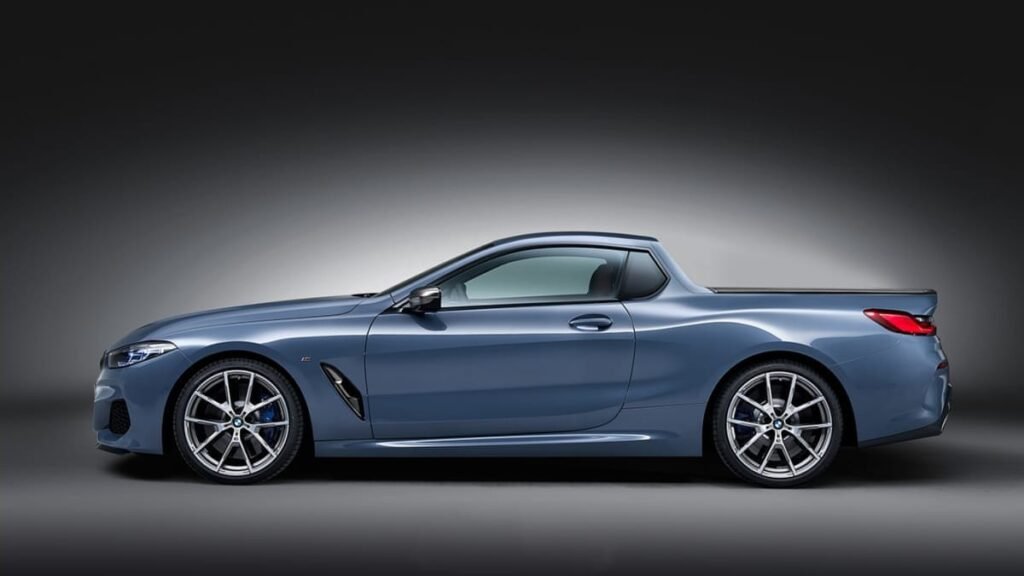
Of all the body styles the car industry has invented, the ute may be the most honest: a passenger car in front, an open tray behind, and no pretence about doing both jobs. America had its Ranchero and El Camino, but the format belongs to Australia, where it was a mainstream way of life for more than 80 years. Europe, by contrast, never took to it at all. What Europe did produce, in the internet era, was a thriving fantasy league of utes that could never exist, drawn by rendering artists and, just occasionally, built for real by the manufacturers themselves. The two photographs on this page sum the story up: a genuine Australian Holden Commodore Ute, and a BMW 8 Series pickup that exists only in pixels.
An Australian invention, born of a farmer’s letter
The ute’s origin story is well documented. In 1933 the wife of a farmer in Gippsland, Victoria, wrote to Ford Australia explaining that she and her husband could not afford both a car and a truck: they needed something respectable enough for church on Sunday that could still take pigs to market on Monday. Ford’s managing director passed the letter to the company’s only designer, 23-year-old Lew Bandt, who drew a coupe body with an integrated steel load tray behind the cabin. Production of the Ford coupe utility began in January 1934, with a payload of 545 kg. Holden followed in 1951 with the 50-2106 coupe utility, and the format became an Australian institution, evolving from farm transport into V8-powered performance cars in its own right. The end came on 20 October 2017, when the last Australian-built Holden, a Commodore, left the Elizabeth plant and local production of the ute died with it.

X-Tomi and the European fantasy league
Keeping the idea alive in Europe is X-Tomi Design, the Hungarian rendering studio that has spent years applying the ute treatment to sports cars, crossovers and supercars. The back catalogue is gloriously implausible. In 2013 X-Tomi published a Rolls-Royce Ghost with a cargo bed; a Lamborghini Urus pickup followed, its long wheelbase suiting the format suspiciously well; and when the Rolls-Royce Cullinan arrived in 2018, the studio rendered it in six body styles, a pickup among them. BMW’s big coupes have been favourite subjects, from an M8 ute drawn from the Concept 8 Series in 2017 to the production 8 Series pickup pictured here. None of these cars was ever an official project, and that is rather the point: freed from crash regulations, market research and common sense, the luxury ute is pure wish fulfilment, a Phantom-grade cabin with somewhere to put a bicycle.
When the factories actually built one
Twice, though, a European manufacturer has done the job properly. In 1986 BMW M needed a vehicle to move parts and equipment around its Garching premises, so it converted a 3 Series Convertible body into an M3 pickup. It kept the standard car’s narrow body rather than the M3’s flared arches and was powered first by the 2.0-litre, 192 hp engine from the Italian-market M3, later by the proper 2.3-litre unit with 200 hp. The pickup worked on the factory site for more than 26 years before being retired. Its replacement, built in 2011 on an E92 M3 Convertible, was launched with a straight face on 1 April as a supposed fourth M3 body variant: 420 hp, a 450 kg payload and Nürburgring spy shots to fuel the rumour. Only the last paragraph of BMW’s release admitted it was a one-off workshop vehicle, although unlike its predecessor it was licensed for road use. The episode remains the best April Fools’ joke in the industry precisely because the car was real.
Honda’s engineers played the same game in Britain. Project P, revealed in May 2018, was a Civic Type R pickup built by a specialist team at the Swindon factory from a pre-production car, in about four weeks. Everything from the B-pillar back was reworked into a flat bed, the famous rear wing stayed, and the mechanical package was untouched: a 2.0-litre turbocharged engine with 320 PS and 400 Nm, a six-speed manual gearbox and front-wheel drive. Honda estimated 0 to 62 mph in under six seconds and a top speed above 165 mph, which would have made it one of the fastest pickups on British roads. It was a demonstration of the same skunkworks spirit that produced cars like the Honda NSX, and, like the BMWs, it was never intended for production.
| BMW M3 Pickup (1986) | E30, built from a 3 Series Convertible; 2.0-litre 192 hp, later 2.3-litre 200 hp; factory transport at Garching for over 26 years |
|---|---|
| BMW M3 Pickup (2011) | E92, 4.0-litre V8, 420 hp; 450 kg payload; one-off, road-registered, launched as an April Fools’ story |
| Honda Civic Type R Pickup (2018) | “Project P”; 2.0-litre turbo, 320 PS, 400 Nm; 0-62 mph under 6.0 s and over 165 mph (both estimated); one-off concept |
| X-Tomi Design renders | Rolls-Royce Ghost and Cullinan, Lamborghini Urus, BMW M8 and 8 Series pickups; digital only, never built |
Why Europe still says no
The pattern is consistent: Europeans will draw a luxury ute, applaud a factory one-off and then buy something else. Buyers who genuinely need a load bed choose ladder-frame trucks such as the Mazda BT-50 or vans, while the car-based ute’s blend of comfort and modest capacity answers a question few European customers ask. Even when a European brand builds a thoroughly competent pickup, it may skip its home market entirely, as Peugeot did with the Peugeot Landtrek. BMW’s own adventures stayed behind factory gates, and the BMW M5 line has never come near a load bed. Since Australian production ended in 2017, the ute has survived mainly as an idea, and ideas, unlike tooling, cost nothing to keep in production.
The unusual pickup is really two stories. The first is a genuinely great invention, born in Australia in 1934, that served farmers, families and V8 enthusiasts for eight decades before its industry disappeared. The second is Europe’s long-running daydream, in which X-Tomi’s renders imagine luxury utes no board would approve, while BMW and Honda proved, with real metal, that the concept works beautifully whenever engineers are allowed to build exactly one. Until a manufacturer finds a business case, the European ute will remain what it has always been: a wonderful car that nobody can buy.


