




07 Nov 2026
0
Best 3-Row Electric SUVs 2026: Kia EV9 vs Hyundai Ioniq 9 vs Rivian R1S
Three-row electric SUVs are finally a real choice for American families in 2026 — not a single expensive outlier. The short answer: the Hyundai Ioniq 9 is the best all-rounder, with the longest range (335 miles) and the most cargo space behind the third row; the Kia EV9 is the best value, starting at $54,900 with the same 800-volt fast charging; and the Rivian R1S is the best adventure SUV, but it now starts at $83,990 after Rivian dropped its cheapest trim.
The EV9 and Ioniq 9 seat six or seven; the R1S seats seven. All three plug into Tesla Superchargers with a built-in NACS port, no adapter needed. And none of them qualifies for the $7,500 federal tax credit anymore — that ended September 30, 2025.
If you only need one number: the Ioniq 9’s base trim is the only one of the three where the cheapest version is also the longest-range version. That is rare, and it is why the Ioniq 9 leads this comparison.
The three SUVs at a glance
| Kia EV9 | Hyundai Ioniq 9 | Rivian R1S | |
|---|---|---|---|
| Starting MSRP | $54,900 (Light RWD) | $58,955 (S RWD) | $83,990 (Dual Large) |
| Destination charge | $1,645 | $1,600 | $1,895 |
| Max EPA range | 305 mi (Light Long Range) | 335 mi (S RWD) | 410 mi (Dual Max) |
| Base-trim range | 230 mi (Light RWD) | 335 mi (S RWD) | 329 mi (Dual Large) |
| Battery | 76.1 or 99.8 kWh | 110.3 kWh (all trims) | Large or Max pack |
| Power | 201–215 hp RWD; 379 hp AWD | 215 hp RWD; 303–422 hp AWD | 533 hp (up to 665 hp upgrade) |
| Seating | 6 or 7 | 6 or 7 | 7 |
| Cargo behind 3rd row / max | 20.2 / 81.7 cu ft | 21.9 / 86.9 cu ft | 17.6 / 104.7 cu ft |
| Max towing | 5,000 lbs (AWD) | 5,000 lbs (AWD) | 7,700 lbs |
| DC fast charge, 10–80% | ~24 min (350 kW) | 24 min (350 kW) | ~20 min for 140 mi added |
| Charging port | NACS | NACS | NACS |
| Battery warranty | 10 yr / 100,000 mi | 10 yr / 100,000 mi | 8 yr / 150,000 mi |
Prices are manufacturer MSRP before destination, taxes and fees. Range figures are EPA estimates. Sources: Kia, Hyundai, Rivian. Rivian’s 104.7 cu ft maximum includes its front trunk; the Korean pair’s figures are rear cargo only. Rivian’s 175,000-mile battery cover applies only to the Quad.
Read this before you trust the headline prices
The EV9’s 305-mile range does not belong to the $54,900 car. The base Light RWD costs $54,900 but goes 230 miles on its 76.1 kWh battery. The 305-mile figure belongs to the Light Long Range RWD at $57,900, with the bigger 99.8 kWh battery. That is still a good price for 305 miles — but the two numbers come from two different trims, and most ads blur them together.
The Rivian R1S no longer starts at $76,990. Rivian discontinued the Dual Standard trim in late June 2026, ahead of the R2 launch. The entry point is now the Dual Large at $83,990 (329 miles), and the 410-mile Dual Max costs $7,000 more, at $90,990. Any guide still quoting $76,990 is out of date.
The Ioniq 9’s headline is honest. Its $58,955 base S trim is the one with the 335-mile range — every Ioniq 9 carries the same 110.3 kWh battery, so you do not pay more to get the range. Add the $1,600 destination charge and the as-sold starting price is $60,555.
None of the three gets a $7,500 federal credit on a purchase. The federal clean-vehicle credit ended for vehicles acquired after September 30, 2025. If a dealer still advertises $7,500 off one of these, ask exactly which credit it is and get it in writing — the purchase credit is gone. Our EV tax credit guide explains what changed, and our cheapest electric cars guide covers the models that still make sense at lower prices.
Kia EV9 — the value pick
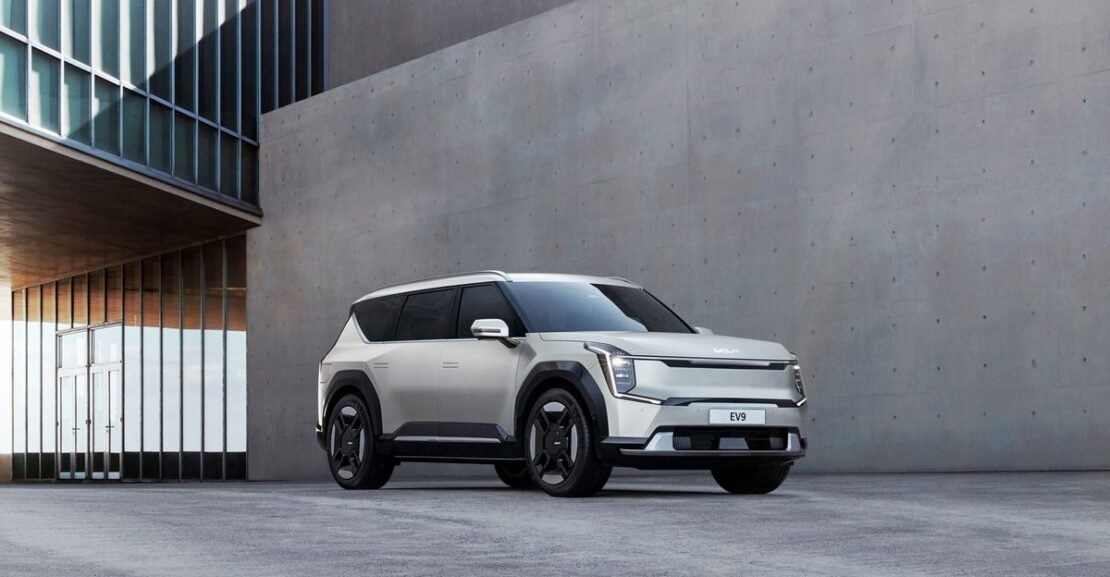
Why buy it? The EV9 is the cheapest way into a proper three-row electric SUV, and it does not feel like a compromise. The Light Long Range at $57,900 gives 305 miles of EPA range, and the 800-volt architecture charges 10–80% in about 24 minutes on a 350 kW charger (Kia’s claim). Every trim offers vehicle-to-load — you can run a fridge, a laptop or a campsite off the battery.
The boxy shape pays off inside: 20.2 cubic feet of cargo with all three rows up, and a genuinely usable third row with 30.8 inches of legroom with the bench seat, or 32.0 inches with captain’s chairs. AWD versions make 379 hp and tow up to 5,000 lbs.
What to consider: The base Light’s 230-mile range is the weakest base range here, and its smaller battery means more frequent charging on road trips.
The EV9 is also the oldest design of the three — it arrived as a 2024 model — so its cabin tech and driver-assistance feel a step behind the Ioniq 9. And watch the trim ladder: the sweet spot is the Light Long Range, but Wind AWD ($63,900) is the first trim with dual motors, so all-weather buyers pay at least $6,000 more than the range king.
Best for: Families who want the lowest entry price into a three-row EV and mostly charge at home. If your daily driving is under 150 miles and you take two or three road trips a year, the Light Long Range is the value pick of this whole comparison.
Hyundai Ioniq 9 — the all-rounder
Why buy it? The Ioniq 9 is the most complete family EV here. Its base S trim costs $58,955 and goes 335 miles — the longest base range in the class — because every trim shares the same 110.3 kWh battery. It is also the roomiest: 21.9 cubic feet behind the third row and 86.9 cubic feet maximum, more than the EV9 at every seat position, with 32 inches of third-row legroom.
It charges 10–80% in 24 minutes on a 350 kW DC charger, has a built-in NACS port for Tesla Superchargers, and Hyundai’s own page lists a 10–100% home charge in about 9 hours 40 minutes on a 240V charger. It was named a 2026 IIHS Top Safety Pick+ and U.S. News’ 2026 Best Midsize Electric SUV for Families, and it holds a five-star overall safety rating from NHTSA.
What to consider: It costs about $4,000 more than the equivalent EV9, and the styling divides opinion — the long, aerodynamic body looks nothing like a traditional SUV.
The AWD versions (303 hp in SE/SEL, 422 hp in the Performance trims) trade range for power: 320 miles for SE/SEL, 311 for the top trims. The Calligraphy Design tops out at $76,490, which is real luxury-SUV money.
Best for: Buyers who want one car to do everything — school run, road trip, ski trip — without thinking about range. If you can only have one family car and it must be electric, the Ioniq 9 S is the default answer.
Rivian R1S — the adventure pick
Why buy it? The R1S is the only one here that is a genuine off-roader as well as a family SUV. It tows 7,700 lbs — more than 50% more than either Korean SUV — has real ground clearance and off-road modes, and its Dual Max battery is rated at 410 miles, the longest range of any three-row electric SUV on sale.
Even the entry Dual Large makes 533 hp (up to 665 hp with the Performance upgrade) and hits 60 mph in 4.5 seconds. The Tri Max does it in 2.9 seconds. Rivian’s software, over-the-air updates and adventure-ready accessories (roof tent, camp kitchen) are a class apart.
What to consider: Price, first and last. The R1S now starts at $83,990 before the $1,895 destination charge, and the 410-mile version costs $90,990. That is about $25,000 more than a comparable Ioniq 9.
The cargo area is also smaller than the numbers suggest: 17.6 cubic feet behind the third row is the least here, and Rivian’s 104.7 cu ft maximum includes the front trunk. Rivian is a younger company with a smaller service network than Kia or Hyundai, and its battery warranty — 8 years or 150,000 miles on the volume trims — is shorter than the Koreans’ 10-year coverage. The Tri Max ($106,990, 371 miles) and Quad Max ($121,990, 374 miles, 1,025 hp) are halo cars, not family value.
One naming note if you shop in late 2026: for the 2027 model year Rivian renamed the Dual “Premium” and the Tri “Performance.” Same trucks, new badges.
Best for: Buyers who tow, camp, or drive rough roads and want the most capable three-row EV regardless of price. If your weekends involve a boat, a trailer or a dirt track, the R1S earns its premium. If they involve school and Costco, it does not.
The third row and cargo: the family test
The Ioniq 9 has the best third row for adults. Its 32 inches of third-row legroom and 21.9 cubic feet of cargo with all seats up mean six or seven people plus a week’s groceries actually fit.
The EV9 is close behind at 20.2 cubic feet, and its boxier roofline gives better third-row headroom. The R1S has the tightest third row of the three — fine for kids, a squeeze for adults — and the least cargo behind it (17.6 cu ft), though its front trunk swallows charging cables and small bags that would otherwise eat cabin space.
A practical rule: if you regularly carry six or seven people and luggage, the Ioniq 9 or EV9 works; the R1S works best with five people and the third row folded (about 47 cu ft). Test-fit your own car seats before you buy — LATCH anchors and third-row access vary more between these three than the spec sheets suggest.
Charging and road trips
All three now use the Tesla Supercharger network without an adapter. The EV9 and Ioniq 9 have built-in NACS ports, and 2026 Rivians ship with a native NACS port too. That matters more than any charging-speed number, because Superchargers are the most reliable fast-charging network in the US.
On speed, the Korean pair wins — with one caveat. Both the EV9 and Ioniq 9 ride on the E-GMP platform with 800-volt architecture and charge 10–80% in about 24 minutes on a 350 kW DC fast charger. But Tesla’s V3 Superchargers run at 400 volts, and Hyundai quotes about 40 minutes for a 10–80% charge on one — the 24-minute figure needs an 800-volt charger. The R1S peaks at 220 kW; Rivian says it can add up to 140 miles of range in about 20 minutes. In practice, all three add a useful road-trip charge in the time it takes to buy lunch — the difference is minutes, not hours.
Home charging is where the money is saved. The Ioniq 9 takes about 9 hours 40 minutes for a full charge on a 240V home charger (Hyundai’s figure), so an overnight charge covers even the big 110.3 kWh battery. If you cannot charge at home, read our electric car charging costs guide first — public fast charging can cost more per mile than gasoline, as the worked example below shows.
What it actually costs to own
The worked example: home charging saves about $1,546 a year. Take the EV9 AWD, which uses about 41 kWh per 100 miles (83 MPGe combined). Over 12,000 miles a year that is 4,920 kWh. At the US average residential electricity price of 18.16 cents per kWh (EIA, August 2026), home charging costs $893 a year. A gasoline three-row SUV averaging 21 mpg combined — the EPA figure for an AWD Kia Telluride — burns 571 gallons over the same distance. At the EIA national average of $4.269 a gallon (week of October 26, 2026), that is $2,439 a year.
The saving is $1,546 a year, or $7,730 over five years — before any maintenance savings (no oil changes, fewer brake jobs).
But the saving depends entirely on where you charge. Those same 4,920 kWh at a public DC fast charger averaging 54 cents per kWh cost $2,657 a year — more than the gasoline SUV. Home charging is what makes a three-row EV cheaper to run; without it, the fuel argument disappears. That is the single most important ownership fact in this article.
Monthly payments (Experian Q2 2026 average new-car APR, 6.35%, over 60 months):
- EV9 Light Long Range ($59,545 with destination, $5,000 down): about $1,063 a month
- Ioniq 9 S ($60,555 with destination, $5,000 down): about $1,083 a month
- R1S Dual Large ($85,885 with destination, $10,000 down): about $1,479 a month
Our auto loan guide explains how APR, term and down payment move those numbers, and our bad-credit car loans guide covers approval with a lower credit score. Insurance is the other running cost to check before you buy — large electric SUVs cost more to insure than their gasoline equivalents, so get quotes first with our car insurance quotes guide.
How to choose
- Budget under $60,000: Kia EV9 Light Long Range ($57,900, 305 miles). The cheapest 300-mile three-row EV.
- One car for everything: Hyundai Ioniq 9 S ($58,955, 335 miles). The longest base range and the most space.
- Towing or off-road: Rivian R1S Dual Large ($83,990, 329 miles) or Dual Max ($90,990, 410 miles). Nothing else in this class tows 7,700 lbs.
- Seven adults regularly: Ioniq 9 first, EV9 second. Test the R1S third row in person before committing.
- No home charging: Think twice about any of them. Run the numbers in our charging costs guide — public fast charging can erase the fuel saving.
- Still deciding between electric and hybrid? Our best hybrid SUVs guide covers the RAV4 Hybrid and CR-V Hybrid class, and our best electric cars guide ranks the wider 2026 EV market.
Also worth a look
The Cadillac Vistiq starts at $77,395 with 305 miles of EPA range — a luxury three-row EV that slots between the Ioniq 9 and the R1S on price. The Tesla Model X and Volvo EX90 are the other premium three-row electrics, both priced well above $80,000 with longer standard-equipment lists but less value per dollar. None of them changes the verdict above: the mainstream choice is Korean, and the adventure choice is the Rivian.
FAQ
Which 3-row electric SUV has the longest range?
The Rivian R1S Dual Max, at 410 miles EPA-estimated. Among the base trims, the Hyundai Ioniq 9 S leads at 335 miles, ahead of the Kia EV9 Light Long Range at 305 miles.
What is the cheapest 3-row electric SUV in 2026?
The Kia EV9 Light RWD, from $54,900 before the $1,645 destination charge. Note its range is 230 miles — the 305-mile version costs $57,900.
Is the Rivian R1S still available from $76,990?
No. Rivian discontinued the Dual Standard trim in late June 2026. The R1S now starts at $83,990 for the Dual Large with 329 miles of range.
Do these SUVs qualify for the $7,500 federal EV tax credit?
No. The federal credit for buying an EV ended for vehicles acquired after September 30, 2025. None of the EV9, Ioniq 9 or R1S qualifies on a purchase.
Can the EV9, Ioniq 9 and R1S use Tesla Superchargers?
Yes. All three have built-in NACS ports in 2026, so they plug into Tesla Superchargers without an adapter. Note that the 800-volt EV9 and Ioniq 9 charge slower on 400-volt V3 Superchargers — Hyundai quotes about 40 minutes for a 10–80% charge, versus 24 minutes on a 350 kW charger.
Which 3-row electric SUV is best for towing?
The Rivian R1S, rated at 7,700 lbs. The Kia EV9 and Hyundai Ioniq 9 both tow up to 5,000 lbs with all-wheel drive.
Which 3-row electric SUV has the most cargo space?
Behind the third row, the Hyundai Ioniq 9 leads with 21.9 cubic feet, ahead of the EV9 (20.2) and R1S (17.6). For maximum total volume, the R1S leads at 104.7 cubic feet — but that figure includes its front trunk; the Ioniq 9 offers 86.9 cubic feet of rear cargo and the EV9 81.7.
How much does it cost to charge a 3-row electric SUV at home?
About $893 a year for 12,000 miles in an EV9 AWD at the US average residential electricity price of 18.16 cents per kWh — roughly $1,546 a year less than a gasoline three-row SUV at 21 mpg.
Bottom Line
For most families, the Hyundai Ioniq 9 S is the best 3-row electric SUV of 2026: 335 miles of range, the roomiest cabin, fast charging, and a $58,955 starting price. The Kia EV9 Light Long Range is the value alternative at $57,900 with 305 miles — the right pick if you want to spend the least. The Rivian R1S is the most capable and the most expensive; buy it for towing and adventure, not for value. Whichever you choose, make sure you can charge at home — that is what turns an electric three-row SUV from an expensive novelty into the cheapest family car to run.
Sources & Pricing Note
Prices and range figures are manufacturer MSRP and EPA estimates as published in November 2026: Kia EV9 (Light RWD $54,900, Light Long Range $57,900, Wind $63,900, Land $68,900, GT-Line $71,900; $1,645 destination); Hyundai Ioniq 9 (S $58,955, Calligraphy $74,990, Calligraphy Design $76,490; $1,600 destination; 335/320/311-mile EPA figures by trim); Rivian R1S (Dual Large $83,990, Dual Max $90,990, Tri Max $106,990, Quad Max $121,990; $1,895 destination; battery warranty 8 years/150,000 miles, 175,000 miles on Quad; Dual Standard discontinued June 2026). Electricity and gasoline prices are U.S. Energy Information Administration figures: residential electricity 18.16 cents/kWh (August 2026) and regular gasoline $4.269/gallon (week of October 26, 2026). Consumption: EV9 AWD 41 kWh/100 miles (83 MPGe combined, FuelEconomy.gov). APR: Experian Q2 2026 average new-car APR, 6.35%. MSRPs exclude destination (shown separately above), taxes, title, license, dealer fees and options. EPA range varies with wheel size, temperature, speed and driving style. Verify the price, the trim’s range and any incentive with the dealer before you buy — Rivian’s lineup in particular changed during 2026.
Last updated: November 2026
About the Author
Written by William, founder and editor of MotorAmaze. MotorAmaze covers electric cars, car finance and car insurance for US and UK buyers, with every price and range figure checked against the manufacturer’s own published figures. This article is based on manufacturer specifications and EPA estimates; MotorAmaze has not independently road-tested these vehicles.