
Suzuki Across: the RAV4 Plug-in Hybrid in Suzuki Badges

There was no point pretending otherwise, and Suzuki did not try. When the Across was revealed on 1 July 2020, the company said plainly that it was the first model supplied by Toyota under the collaborative business agreement between the two Japanese manufacturers. Underneath the Suzuki badges sits the Toyota RAV4 plug-in hybrid, built by Toyota and given a Suzuki front end, and the arrangement made complete sense: Suzuki needed a large, low-emissions flagship to pull its European fleet carbon dioxide average down, and Toyota had the most efficient big hybrid system in the business sitting on the shelf.

Why Suzuki needed a Toyota
The background is the alliance the two companies had been building since 2017, formalised in a March 2019 agreement under which Toyota would supply Suzuki with two electrified vehicles for Europe, built on Toyota platforms: the RAV4-based Across and a Corolla-based estate that followed as the Swace. Suzuki’s own European range was made up of small cars, the Swift, Vitara and Jimny among them, which were efficient individually but left the brand without a heavyweight model and exposed to tightening fleet emissions rules. A plug-in hybrid with a 22 g/km rating was worth more to Suzuki’s compliance maths than any car it could have developed itself in the time available, and the Across duly became the largest and most powerful Suzuki ever sold in Europe.
The plug-in system
The hardware is Toyota’s, and it is good hardware. A 2.5-litre Atkinson-cycle petrol engine (A25A-FXS) makes 185 PS (136 kW) and 227 Nm, working with a 134 kW front electric motor and a smaller 40 kW motor on the rear axle, the combination giving all-wheel drive without a propshaft, which Suzuki calls E-Four. Suzuki quotes a system output of 306 PS (225 kW), about 302 hp, fed by an 18.1 kWh lithium-ion battery mounted under the floor. The official figures are strong for the class: 75 kilometres of electric-only range on the WLTP cycle, carbon dioxide emissions of 22 g/km, 0 to 100 km/h in 6.0 seconds and a top speed of 180 km/h. An e-CVT handles the blending of engine and motors in the seamless Toyota fashion.
| Petrol engine | 2.5-litre four-cylinder (A25A-FXS), 185 PS (136 kW), 227 Nm |
|---|---|
| Electric motors | Front 134 kW / 270 Nm; rear 40 kW / 121 Nm (E-Four all-wheel drive) |
| System output | 306 PS (225 kW), about 302 hp |
| Battery | 18.1 kWh lithium-ion, under the floor |
| Electric range | 75 km (WLTP); CO2 22 g/km (WLTP) |
| Performance | 0 to 100 km/h in 6.0 seconds; top speed 180 km/h |
| Gearbox | e-CVT |
| On sale | Revealed 1 July 2020; European sales from autumn 2020 |
What Suzuki changed
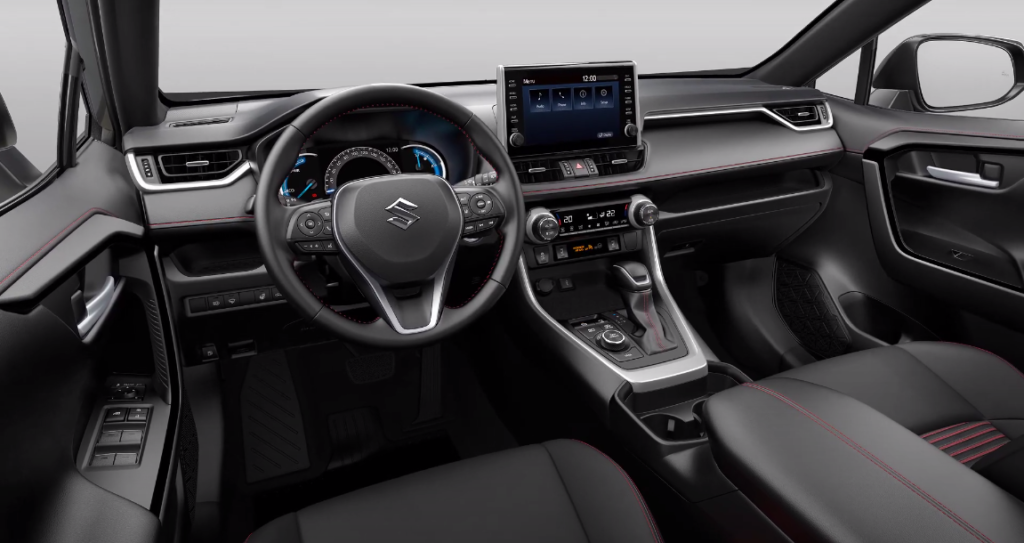
Not much, and honestly. The Across keeps the RAV4’s body sides, glasshouse, interior and platform (TNGA-K), with the differentiation concentrated at the front, where a larger grille, reshaped bumper and slimmer headlights give it a face closer to Suzuki’s own design language, plus Suzuki badging and its own wheel designs. Inside, the dashboard, screens and switchgear are Toyota’s, which owners experience as a compliment: the RAV4’s cabin was one of the better ones in the class. Suzuki sold the Across in a single, well-equipped specification in most European markets, a deliberate simplification that suited a low-volume flagship. Kerb weight is a substantial 1,940 kg, the price of a big battery and two motors, though the electric range means many owners can commute for weeks without the petrol engine waking up at all.
Charging and living with it
A plug-in hybrid only delivers its paper economy if it is charged, and the Across made that easy enough. Cars tested later in the model’s life carried a standard 6 kW onboard AC charger that refilled the battery in about two and a half hours on a wallbox; the earliest cars, with a lower-rated charging cable, needed around five and a half hours, a reminder to check the specification of a used example. Driven as intended, charged at home and used electrically for the daily commute, the big Suzuki could go weeks between petrol stops, while the E-Four system and the hybrid’s instant torque made it a relaxed long-distance car when the battery was spent. That dual character, electric runabout in the week and all-weather family wagon at the weekend, was the strongest argument for the whole badge-engineering exercise.
Family ties
The Across sits in a Toyota-shaped family tree on this site too: the same hybrid thinking produced the sleeker Toyota Venza and the three-row Toyota Highlander, and the Across’s blend of size and economy pitched it against mainstream rivals such as the Hyundai Tucson. What none of those offered in 2020 was this car’s combination of a genuinely usable electric range and a Suzuki badge, and for the brand’s loyal European buyers, that was the whole point.
Judged as an engineering exercise, the Across is Toyota’s work and none the worse for it: 306 PS, 75 km of electric range and standard all-wheel drive made it one of the strongest plug-in hybrids of its launch year. Judged as a Suzuki, it is a pragmatic flagship bought in rather than built, and the company was commendably honest about that. If the badge matters less to you than the hardware, this was among the most capable family SUVs on sale in 2020.